

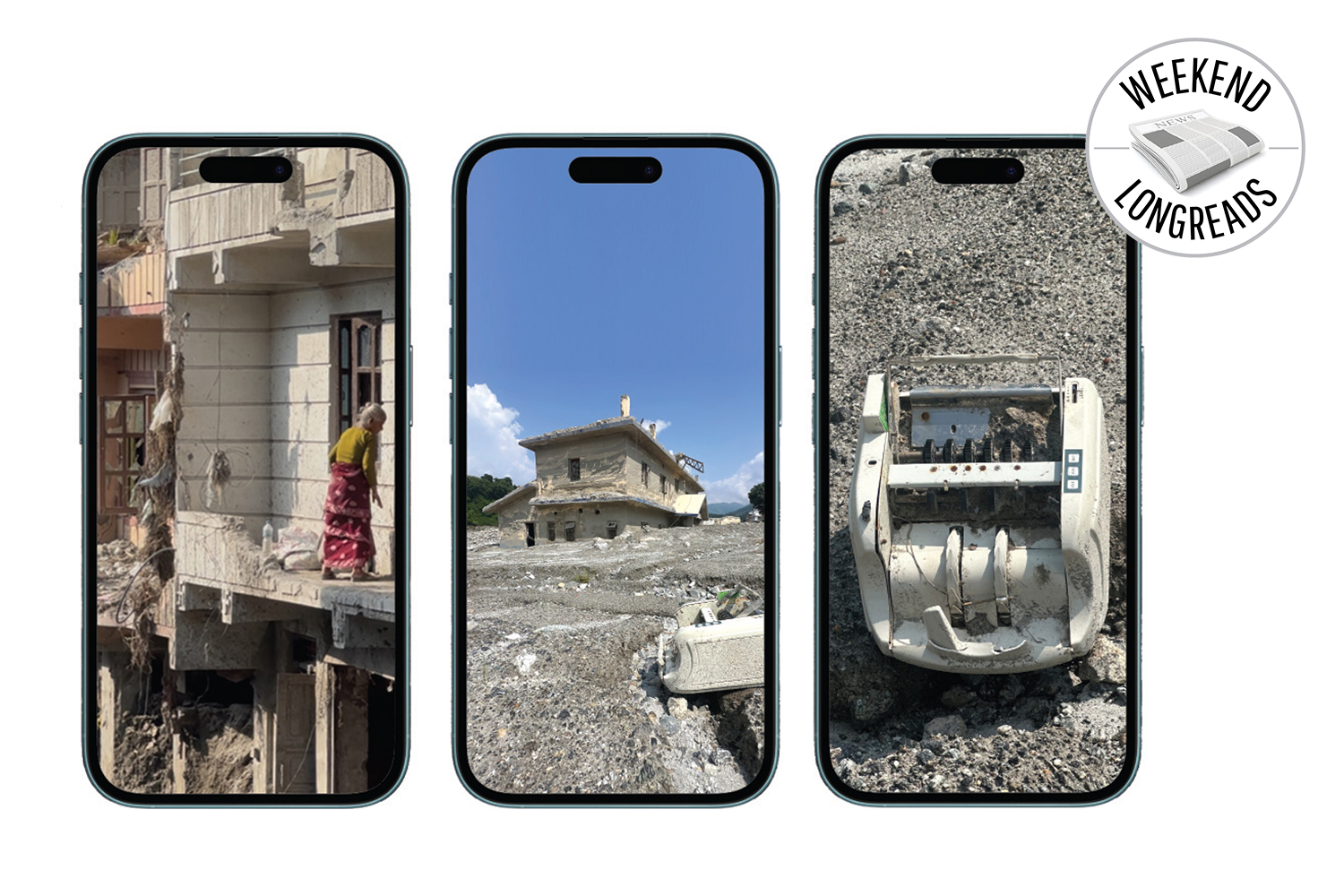
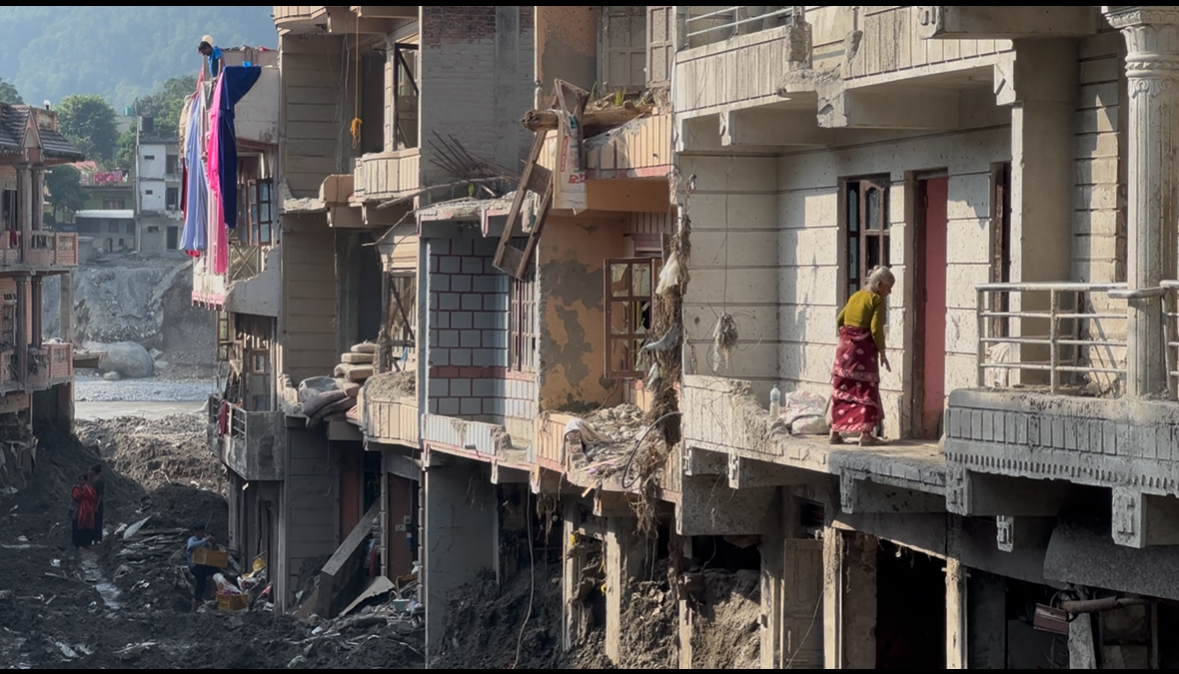
A dark, viscous trench of sludge is where our street used to be in Devighat. An elderly woman in a red sari paces a second-floor balcony with its concrete balustrade missing.
Laundry hangs from exposed rebars of a half-collapsed building. Men are having lunch on a crumbling ledge below an uprooted tree lodged in the floor above them.
These scenes were different from the visual grammar through which I had seen the disaster of my ancestral home online, in which the destruction arrived as a reel.
The Nepali psyche is drowning in 15-second floods of hopelessness. Local heartbreak becomes repeatable content, circulated through systems that measure our attention more readily than they understand our grief. Synthetic sympathy, political performance, and a vocabulary announces that the future is already finished.
One of the viral videos was of the Trisuli bridge being swept away. Next to it stood my grandfather’s metal workshop, where he spent years making grills and teaching people to weld. I learnt it was gone through that reel.
It stripped away memory, physical presence and emotion from the space. The small rectangle in my hand suddenly held more than the comment section could explain about the flood.
This is the intimacy of mediated witnessing – encountering an event through a representation while feeling implicated in its consequences. Mud has no smell on a screen. Yet a familiar location can make the image feel almost tactile.
The viewer personally affected by the disaster knows where that road led, whose business occupied that building, and which part of the landscape should still be there.
A thumb can pause the water, enlarge the damage, replay the collapse. You can comment, share it on Instagram story and describe how maddening it is, while blaming climate injustice.
These gestures offer false control over the representation, exposing our inability to intervene in what has happened.
A viral meme describes climate change as a series of disasters watched through phones, with the footage coming closer and closer until you become the person filming. Environmental catastrophe moves from a news location to our own community. Understanding the multidimensional nature of environmental catastrophe requires more than its most dramatic seconds captured through a phone.
As a child I used to run along Devighat’s steep streets, buying chatpatey from a vendor and finding friends to play chungi with next to the pipal tree and chautara.
Returning after the flood, none of those landmarks remained. My memory supplied roads that the landscape could no longer confirm. Augmented reality provided remembrances of the uphill run, the cart, the platform, the windows.
Environmental philosopher Glenn Albrecht’s concept of ‘solastalgia’ gives language to this distress: the pain of an environment changing around people who remain connected to it, undermining familiarity and security associated with home. A person can remain at home, and still feel homesick.
For those returning to a transformed hometown, the concept also illuminates the distance between geographical arrival and emotional recognition. You can reach the location, and still feel that you have failed to arrive.
The phone allows a place to become unfamiliar even before we physically return. It delivers the rupture, leaving memory to reconstruct what has disappeared outside the frame.
This helps explain the urge to keep watching. A viewer may replay a flood clip to identify a building, locate a relative’s street or understand whether a route remains usable. Repetition is an attempt to regain orientation, and can continue long after the footage has stopped revealing anything new.
What does it mean to inhabit a media environment where searching for evidence of your own loss becomes a signal to deliver more destruction? Where the time spent trying to understand a ruined neighbourhood is processed alongside the time spent watching a cute cat video, yet another advertisement for Xtreme energy drink or an argument between jholey and ghantey.
We have to make sense of a disaster amidst all this noise, where an intimate act of recognition and solidarity becomes another algorithmic spectacle.
TikTok’s account of its recommendation system identifies watch time, viewing completion and other interactions among the signals used to rank content. Concern, disbelief and fascination can all involve sustained attention. A platform can therefore register a video as ‘virally compelling’ when a viewer is trying to comprehend the destruction of home.
This is the content-ification of disaster: the conversion of a situated event into units that can circulate, compete for attention and acquire value through engagement. The place has a history, the clip has a duration.
The impulse is a guilty pleasure, an uncomfortable compulsiveness. But a return to the screen can begin in care, fear or the hope that the next video will clarify what happened. Eventually, watching and rewatching can become the most readily available response to the distress that watching produces.
‘WE’RE SO COOKED’
This repeated, difficult-to-stop consumption of negative information is called doomscrolling. A 2024 study involving 800 university students in Iran and the United States found an association between doomscrolling and existential anxiety. The survey design cannot establish causation, and its findings cannot simply be transferred to Nepali audiences, but it offers a useful starting point to examine how information-seeking becomes entangled with a diminished sense of possibility.
In the fatalistic sense familiar from livestreams, memes and influencer culture, the phrase ‘We’re so cooked’ announces that the outcome has already been decided. Its humour makes helplessness socially shareable. It allows people to acknowledge danger without having to articulate a response.
Applied to a devastated community, the phrase makes a claim far larger than the available evidence. A place has suffered terrible devastation, and a hopeless zoomer and detached doomer’s interpretation extends that destruction indefinitely into the future.




Comments
0 commentsNo comments yet — be the first.