

An hour before sunrise Vinu Peruvannan is finally set to play god.
Clad in crimson and black, donning heavy headgear speckled with wild geranium flowers, his torso covered in ashes, he holds up a mirror. His transition to a Kathivanoor Veeran Theyyam, a ferocious Thiyya warrior-turned-deity, is complete.

This sight alone makes my 488-kilometre journey from Thiruvananthapuram to Kannur, to experience my first-ever Theyyam at the Sree Kathivanoor Veeran temple, at Kavvayi, a 40-kilometre bus ride from the city centre, worth it. The final stretch of the Kaliyatta Maholsavam, a grand, multi-day, often triennial ritualistic Theyyam festival, is underway and fortunately I get there early enough to find myself a seat..
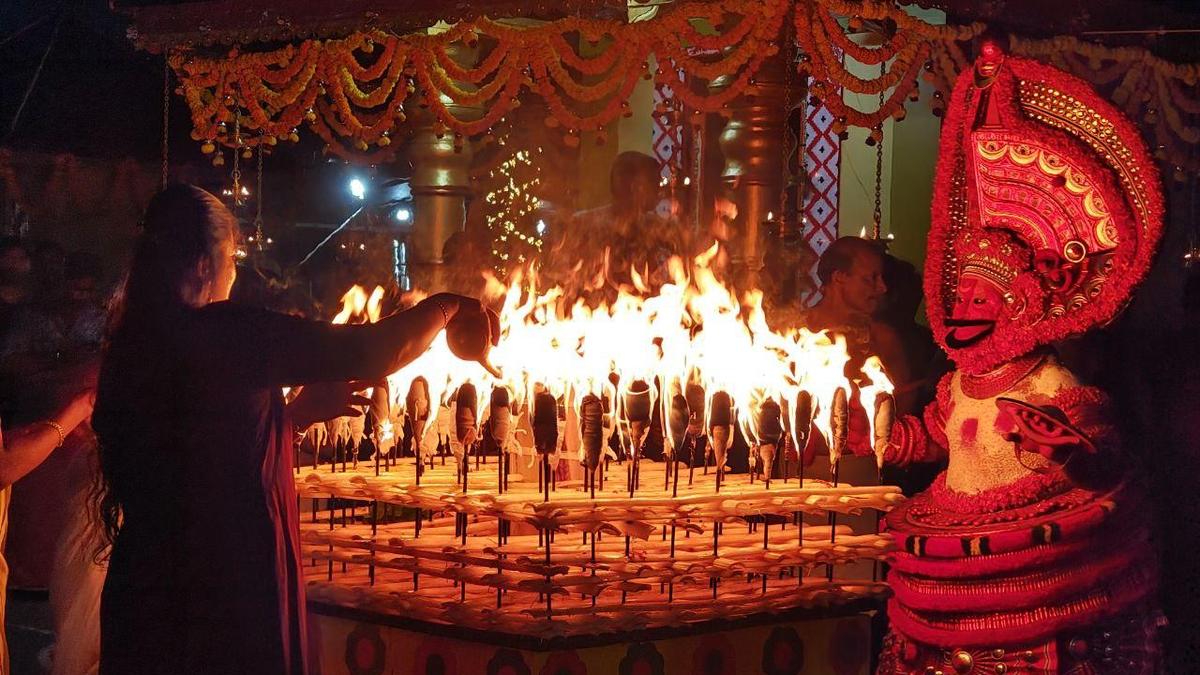
Helpers from the Thalikaran Tharavadu, considered the avakashikal (heirs) of the temple, fling palm-leaf torches outside the room. Amidst the beats of the chenda, the artiste moves backwards into the field in a menacing motion, preparing to perform his tale of valour, heartbreak and rebellion. The chronicles of Kathivanoor Veeran, sung by two helpers, which resounded across the arena all night, have now been replaced by quick beats of the drum.
Kathivanoor Veeran is one among the 456 theyyakolams (types of Theyyams) in Kerala, each entrenched in local myth. North Kerala’s Theyyams are between the 10th day of the Malayalam month of Thulam (mid-October) and Edavappathi (mid-June). “There are over 1,000 Theyyam festivals in a season across North Kerala,” says Santhosh Vengara, a tour guide specialised in Theyyam tours since 2010. They draw more and more tourists every year.
Each of these Theyyam performances involves rites that celebrate local lore – from fasting to the artiste returning to his “human self”, differing in preparation and presentation. Though the art form is rooted in the caste system, it brings in a temporary reversal of hierarchies, with performers from historically marginalised communities, including Vannan, Malayan, Velan, Mavilan, Panan, Pulaya, and Anjoottan, donning the roles of gods. Children belonging to Theyyam-performing families start preparing as early as seven years and transition into playing major Theyyams.
In pictures: Experiencing Theyyam in Kerala
Theyyam is performed only by men who morph into gods, adorning headdresses with colourful feathers and faces painted in vivid hues.
They dance around shrines to the loud beats of the Chenda and the sounds of the cymbals and bless devotees.
The sacred ritual also includes walking on fire.
Theyyam performances are an annual ritual. Performers in elaborate crimson gear blend movements of Kalaripayattu and dramatic rituals.
Theyyam being a ritualistic art form, travellers are expected to respect local customs and traditions, which now include restrictions on photography.
Each of these Theyyam performances involve rites that celebrate local lore. Though the art form is rooted in the caste system, it brings in a temporary reversal of hierarchies, with performers from historically marginalised communities.
The art form ties together the physical and metaphysical, uniting man and God, played out in an overwhelming multi-sensory experience.






Comments
0 commentsNo comments yet — be the first.