

People tend to attribute the current backlash against democracy to exaggerated claims about poor leadership. While leadership plays a vital role in a country’s well-being and society at large, critics raise a deeper concern: expecting extraordinary leaders to embody perfection while creating a shared vision for the future is unrealistic.
Such idealized expectations leave society perpetually striving for an unattainable ideal, inevitably deepening frustration. This way of thinking can distort public understanding and intensify political polarization. It may also spread misinformation in academic literature and, perhaps more importantly, in public discourse.
Nevertheless, over the past thirty-six years, Nepal has made significant progress in embracing liberal ideas and values, particularly the rule of law. Yet, paradoxically, these democratic gains have coincided with growing public disillusionment, increasingly challenging the established logic of realpolitik. This gap between democratic progress and popular dissatisfaction raises fundamental questions about the nature, quality, and sustainability of Nepal’s democratic transformation.
The challenge with perfectionism is that liberty, democracy, cooperation, and human rights—principles that govern Nepal and, as Zakaria (2024) says, emphasize the rules, norms, and values that create forums for discussion, debate, and action—may not be achievable. Yet substantial evidence indicates that the political system the country has adopted has damaged its public image and rapidly eroded public confidence.
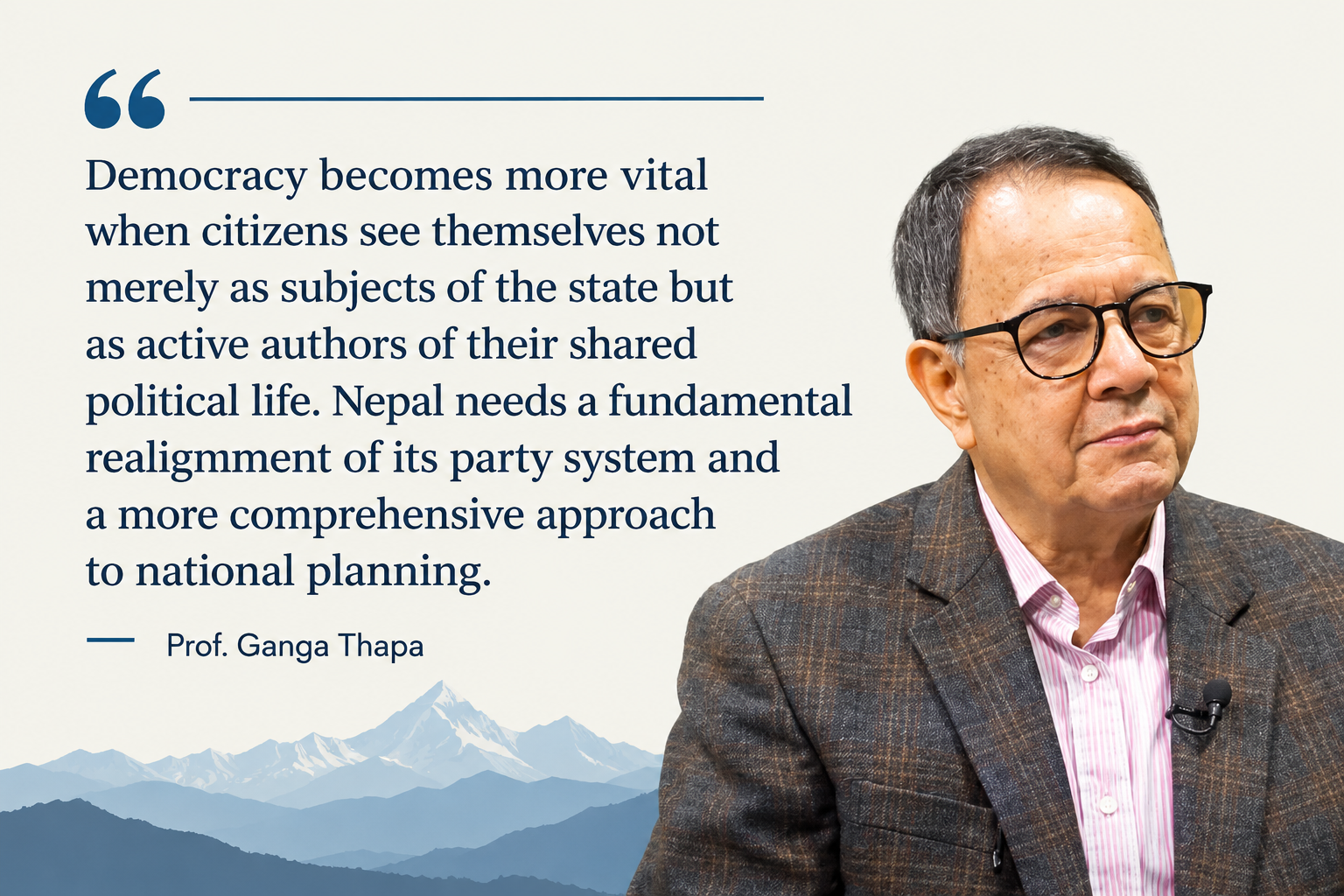
Democracy becomes more vital when citizens see themselves not merely as subjects of the state but as active authors of their shared political life. Nepal needs a fundamental realignment of its party system and a more comprehensive approach to national planning.
Several commentators have proposed a two-step response: first, examine why people favor appealing ideas over evidence; then consider how the political system itself shapes those choices. The aim is to build a healthier public image of democracy.
Since the fall of absolute monarchy in 1990, Nepal has increasingly aligned itself with global rules and norms, particularly those concerning good governance. Yet the actual practice of good governance has become increasingly elusive, and this gap between formal commitments and practical realities is especially troubling.
As everyday life in Nepal grows more complex, effective governance requires greater technical expertise, institutional capacity, and accountability. Yet many Nepalis remain unconvinced that their government can manage strategically important businesses in the public interest. They fear that power and economic resources are concentrated in the hands of a small, influential elite, while unchecked capitalism continues to undermine the livelihoods and well-being of millions across the country.
Expectations for the RSP government are exceptionally high. But its story should not unfold like a Bollywood film, with a hero spending most of the story trapped by pressure, conspiracies, and a villain’s siege, only to emerge victorious in the final scene. Politics is not a movie; it shapes people’s lives.
People are not waiting for a last-minute triumph. They want to experience better governance in their daily lives. If five years bring nothing but stories of struggle, pressure, and political siege, a final victory will not erase public disappointment. In a democracy, what matters most is not the hero’s eventual triumph but the meaningful changes people experience in everyday life.


Comments
0 commentsNo comments yet — be the first.