

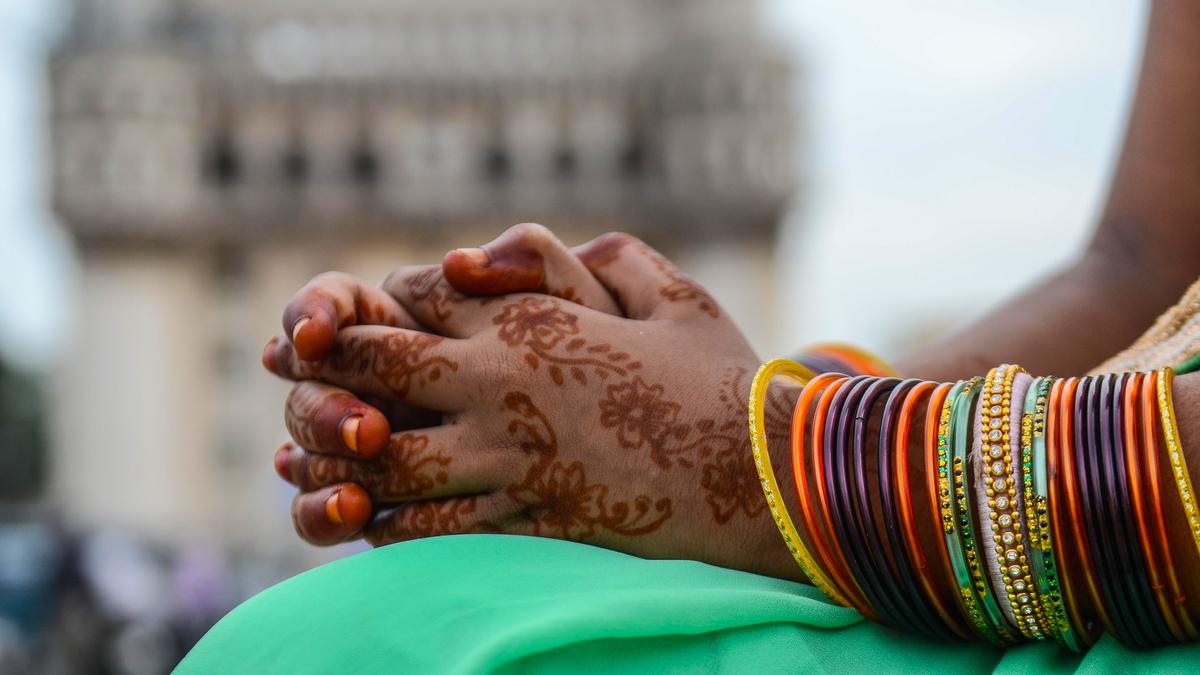
Last December, 15-year-old Tanya* dressed for what she thought would be a temple visit. Her aunt helped her wear a langa voni, the traditional half-saree. Tanya was looking forward to the outing. But the temple visit was only what she had been told; her family was actually preparing for a prospective groom to come and see her, with marriage already being discussed.
A Class VI dropout, Tanya hails from a tribal hamlet in Nizamabad district of Telangana. She is the only child of her mother, who worked as a labourer before health problems forced her to stop. Her estranged father, who has tuberculosis and is unable to work, lives with his first wife and their children.

The man her family wanted her to marry was more than twice her age and worked at a bank. Tanya refused, but her mother and other family members insisted. The marriage was eventually stopped after one of her uncles informed the police about the pelli chupulu, a customary meeting between prospective marriage partners and their families.
The family was called for counselling, while Tanya and her mother spent three days at a Sakhi centre. The intervention stopped the marriage, but it did not alter the circumstances that had placed Tanya at risk of being married off in the first place.
The teenager carries responsibilities far beyond her years. She is the family’s only earning member: she works as an agricultural labourer and stitches traditional Lambada clothes, while cooking, running the household and caring for her mother and grandmother. Yet she is still drawn to the things that belong to her age — volleyball, which she loves and has played at the district level, and cricket with her peers.
“Of all the things, I don’t want to get married now,” she says, sitting beside her mother, whom she accuses of trying to marry her off.
Tanya stopped going to school when her mother fell ill. Her mother often consumes alcohol and blacks out, she says. Returning to school is no longer something she considers; she feels she has forgotten much of what she learnt and does not know how she would resume her studies.
A decline, but not an end
Tanya is one of hundreds of girls across Telangana whose marriages are stopped after relatives, teachers or neighbours alert authorities. Some are married before intervention; some become mothers while still children themselves.
The National Family Health Survey (NFHS)-5, conducted between 2019 and 2021, found that 23.5% of women aged 20-24 in Telangana had married before turning 18, the second-highest proportion in south India after Andhra Pradesh and among the top 10 nationally.
The NFHS-6 figure for 2023-24 was 17.9%, a decline of 5.6 percentage points, against a 3.2-point fall nationally.
The decline, however, does not capture girls still being taken out of school or prepared for marriage. The Telangana Department of Women Development and Child Welfare says 1,245 child marriages were prevented in 2025-26, and another 825 between April and August this year.
“Whenever a child marriage is reported, a case needs to be registered and pursued to its logical conclusion. Merely having laws, Child Marriage Prohibition Officers and helplines is not enough if violations do not result in effective legal action,” says Ravi Kant, national convenor, Just Rights for Children.
“For generations, child marriage has been treated in some communities as a social practice rather than a violation of law. That perception needs to change,” he adds.
Nearly 50 km from Hyderabad, in Nandigama near Shadnagar, 15-year-old Khushi* sits outside her mud-floored home. Unlike Tanya, she enjoys school and wants to continue studying. Last May, however, she was married off to a 40-year-old who ran a toddy shop in a neighbouring village.



Comments
0 commentsNo comments yet — be the first.