

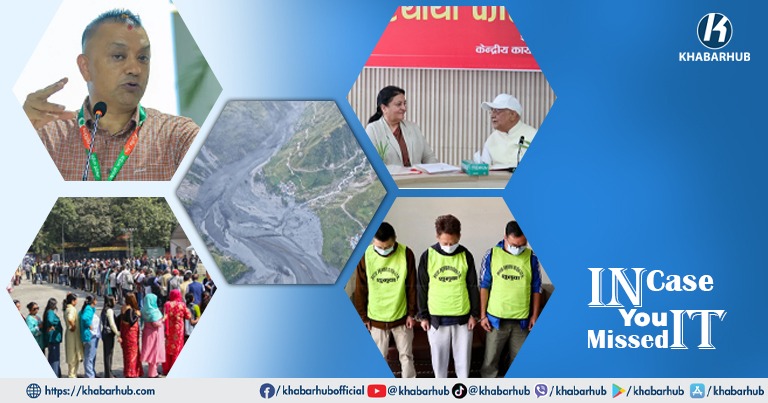
KATHMANDU: Nepal witnessed a consequential week of political realignment, ambitious reform promises and renewed public scrutiny of governance. The election of Gagan Thapa as president of the Nepali Congress (NC), his extensive proposals for party transformation, and Prime Minister Balen Shah’s pledge to resolve the landlessness problem within 1,000 days were among the most significant developments.
Meanwhile, investigations into suspected gold smuggling and money laundering, the government’s response to the Gen Z movement, and Australia’s additional disaster assistance highlighted the challenges and opportunities confronting the country.
Taken together, these developments point to a central question: can Nepal translate public dissatisfaction with traditional political practices into durable institutional reform, accountable government and tangible improvements in citizens’ lives?
Gagan Thapa’s Election: A Mandate for Political Renewal
Gagan Thapa’s decisive victory in the Nepali Congress presidential election represents more than a change of leadership within Nepal’s oldest major democratic party. His reported 6,584 votes against Shyam Krishna Khadgi’s 375 indicate overwhelming support among the participating delegates for Thapa’s candidacy. Of the 7,317 registered delegates, 7,039 cast their ballots, reflecting substantial participation in the party’s internal democratic process.
However, an electoral mandate is not equivalent to a mandate for successful reform. Thapa inherits an organisation shaped by decades of factional competition, patronage networks, leadership disputes and a political culture in which access to power has frequently overshadowed ideological consistency.
Businesses need policy stability, fair regulation and access to finance. At the same time, public-private cooperation must not become a mechanism for distributing state benefits among politically connected firms.
His election therefore presents both an opportunity and a formidable test. The Congress must demonstrate that leadership renewal can change not only who occupies senior positions but also how decisions are made, candidates are selected, public resources are managed and political accountability is enforced.
The decisive nature of Thapa’s victory may strengthen his authority to challenge entrenched interests. Yet the party’s actual transformation will depend on whether that authority is used to build stronger institutions or merely to establish a new centre of influence.
Twenty-Nine Reform Proposals: Ambition Meets Implementation
Thapa’s political report offers a broad diagnosis of the Congress’s weaknesses and an ambitious agenda for the next four years. It acknowledges that the party has prioritised positions and power over its founding principles, while factionalism and the protection of politically connected individuals have undermined public trust.
Such self-criticism is significant in a political environment where parties often explain electoral defeats by blaming opponents, misinformation or temporary public sentiment. Recognising internal failures is an essential first step towards reform. But recognition becomes meaningful only when followed by institutional changes that citizens can observe and evaluate.
Among the most consequential proposals are ending pre-election alliances, strengthening primary elections, selecting candidates according to competence and performance, and refusing to shield party members accused of corruption. The report also advocates independent internal oversight, public audits and a transparent system of organisational accountability.
These proposals directly challenge the patronage arrangements that have historically influenced party politics. Their implementation, however, could encounter resistance from leaders whose influence depends on existing nomination procedures, factional loyalties and discretionary control over party structures.
The crucial test will be whether the new president applies reform principles consistently, including to his supporters. A credible anti-corruption policy cannot distinguish between political allies and opponents, while transparent candidate selection cannot succeed if party rules are altered to benefit particular individuals.
The proposal to introduce a two-term limit for prime ministers also deserves attention. Leadership rotation could reduce the concentration of executive power and encourage political renewal. Nevertheless, such a change would require appropriate constitutional and political processes rather than a unilateral party declaration.
One of the strongest aspects of Thapa’s report is its recognition that the Gen Z uprising of August 2025 should not be dismissed as a conspiracy. By acknowledging public demands for good governance, fairness and opportunity, the Congress leadership appears to recognise that dissatisfaction with established political parties runs deeper than ordinary electoral competition.
The report’s call for an impartial investigation into the use of force, deaths, violence, property destruction and alleged state repression is equally important. A credible investigation must establish individual responsibility, protect due process and ensure that victims receive truth, justice and appropriate reparations.
The government’s decision to forward a committee report on the possible withdrawal of criminal cases against Gen Z protesters to the Home Ministry adds another dimension to this debate. Reviewing cases may help address injustices and distinguish peaceful protest from criminal conduct. However, blanket withdrawal without examining the circumstances of individual cases could undermine accountability and public confidence in the justice system.
The challenge is to reconcile justice with reconciliation. Neither indiscriminate prosecution nor indiscriminate amnesty offers a sustainable solution. Transparent procedures, independent review and equal treatment under the law must guide the process.
For Thapa and the Congress, engagement with younger generations will require more than acknowledging their grievances. It will demand meaningful participation in policymaking, opportunities for leadership and demonstrable changes in how political institutions respond to citizens.
Balen Shah’s Government: Delivering on the Promise of Results
Prime Minister Balen Shah’s pledge to resolve the problems of landless squatters and unorganised settlers within 1,000 days reflects the government’s emphasis on measurable performance. The commitment addresses a longstanding issue that successive governments have struggled to resolve despite repeated promises and the establishment of commissions.






Comments
0 commentsNo comments yet — be the first.