

Summary
- A woman’s refusal to marry a man should be the end of a proposal, not the beginning of a tragedy.
- By rejecting the argument that the refusal of a marriage proposal constituted a mitigating circumstance, the Court confronted not merely an individual crime but the social attitudes that continue to endanger women who exercise their right to choose.
- The rejection of a marriage proposal is not a crime against a man’s honour; killing a woman because she refuses is an assault on her most fundamental rights.
AI Generated Summary
By Muhammad Imran, Staff Member, SAHSOL-LUMS Maria Batool, SASHSOL-LUMS Law Graduate Asma Rahmat, Final Year Law Student, SLC
The killing of a woman for refusing a marriage proposal exposes the patriarchal assumptions that continue to undermine women’s autonomy in Pakistan.
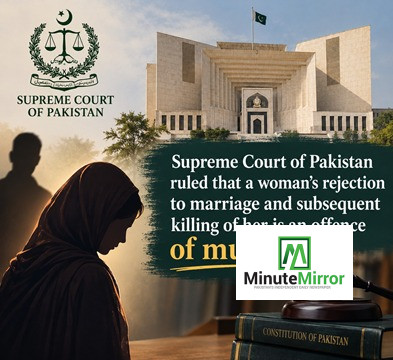
A woman’s refusal to marry a man should be the end of a proposal, not the beginning of a tragedy. Yet, in societies where masculinity is frequently conflated with authority and a woman’s consent is subordinated to male entitlement, rejection can become a pretext for intimidation, coercion and, in its most brutal manifestation, murder. The Supreme Court of Pakistan’s judgment in Muhammad Kamran v. The State and another, Criminal Review Petition No. 73 of 2025, brings this disturbing reality into sharp focus. By rejecting the argument that the refusal of a marriage proposal constituted a mitigating circumstance, the Court confronted not merely an individual crime but the social attitudes that continue to endanger women who exercise their right to choose.
The petitioner, Muhammad Kamran, had been sentenced to death for the murder of Mst. Memoona Shaheen. The prosecution’s case was that he killed her because she and her family had rejected his marriage proposal. Seeking a review of the Supreme Court’s earlier judgment, he argued that the personal and emotional nature of the motive justified converting his death sentence into imprisonment for life. He also relied on the period he had spent in incarceration to invoke the principle of life expectancy. The Court rejected his plea, finding that the circumstances disclosed no compelling mitigating consideration and that the nature of the offence did not warrant the relief sought.
The most significant aspect of the judgment is its rejection of the assumption that a woman’s refusal can somehow diminish the culpability of the man who responds with violence. A rejected proposal may cause disappointment, but disappointment does not confer a right to retaliate. Nor can wounded pride be elevated into a legally acceptable justification for taking another person’s life. The distinction is fundamental: an offender’s motive may help explain his conduct, but it does not necessarily mitigate its gravity. Where a woman is deliberately killed for refusing a marriage proposal, the motive may instead reveal a deeply troubling belief that her autonomy is subordinate to a man’s expectations.
This is precisely where gender sensitivity becomes indispensable to judicial reasoning. Gender-sensitive adjudication does not require courts to abandon established legal principles or presume guilt based on gender. It requires them to examine the facts without reproducing discriminatory assumptions that normalise male control over women. A woman’s refusal is not an act of provocation simply because a man finds it unacceptable. To treat it as such would risk transferring responsibility from the perpetrator to the victim, implying that a woman’s exercise of choice contributed to the violence inflicted upon her.
Such reasoning would be especially dangerous in a society where women’s decisions concerning marriage, relationships and personal independence are still frequently subjected to family and community control. The underlying problem is not merely individual anger. It is the patriarchal notion that a man may claim a woman’s affection, that persistence entitles him to compliance, and that rejection constitutes an affront to his honour. In this distorted worldview, the woman’s independent will becomes an obstacle to be overcome rather than a right to be respected.








Comments
0 commentsNo comments yet — be the first.