


With disasters destroying homes and rising housing costs consuming household incomes, safe and affordable shelter remains out of reach for many Nepalis
A densely populated village in Kavrepalanchowk. Photo courtesy: Habitat for Humanity Nepal
KATHMANDU: As Dashain approaches, households are busy cleaning courtyards and pathways. Had she been at home, Pratima Lama from Syaphrubesi, located in Ward 5 of Gosainkund Rural Municipality, Rasuwa district, would have been busy with the same. However, after being left homeless by the sudden flood on August 26, she has been left destitute. She is currently staying at a Buddhist monastery located in Swayambhu, designated by the government in Kathmandu. The stay at the monastery has become suffocating for her. About 400 flood victims, including her, are staying there.
The large hall of the monastery has been arranged so that men and women can stay separately. On one side, about 150 people, including women and children, have to sleep on beds lined up in a row. They have been provided with food, blankets, mattresses, and clothing collected from supportive donors. However, this collective living has become even more distressing for the visually impaired Lama.
Lama, a teacher at Komin Shyamey Wangphel Secondary School in Rasuwa, used to have her own home. She had built the house by taking loans and borrowing about Rs 12 million. An NMB Bank branch operated in the house. By combining her monthly house rent of Rs 75,000 and her salary, she was paying off the loan taken to build the house.
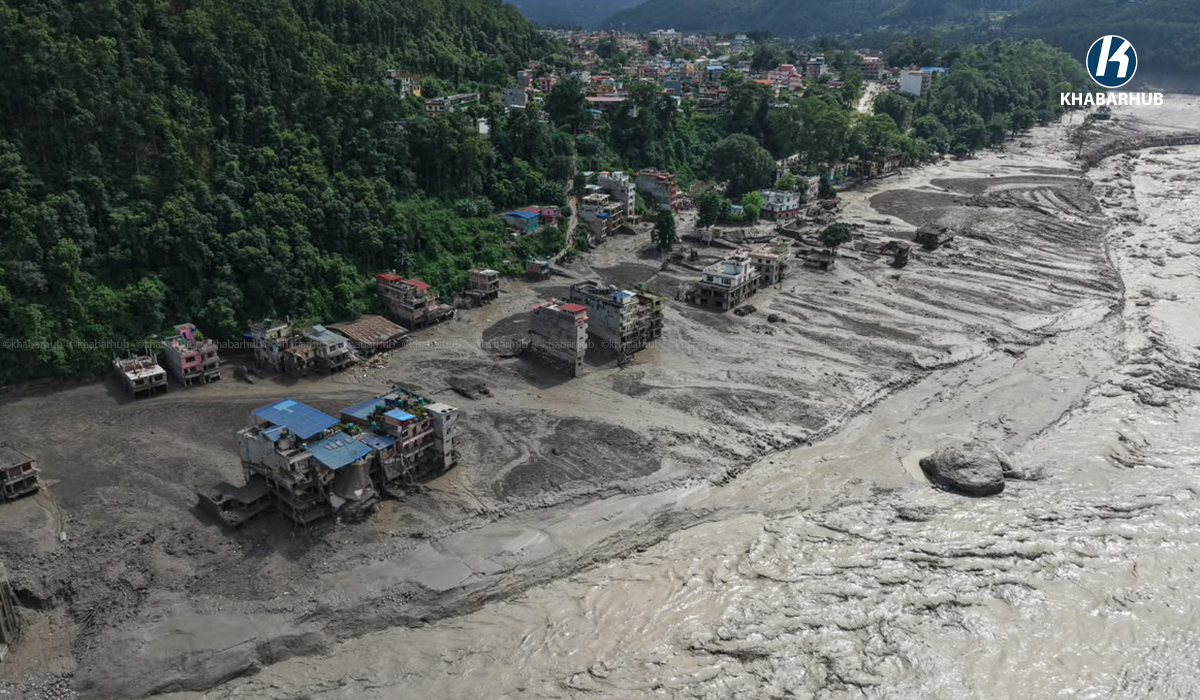
A flash flood triggered by a glacier and rock collapse from the northern slope of Langtang Lirung damaged 7,570 private homes along the Bhote Koshi and Trishuli river corridors.
In Lama’s own words, the house she built for secure living in the future was washed away by a moment of destructive flood. Having arrived at the collective living of the monastery afterward, she says, “Since we have to live in a group here, there is no privacy; even changing clothes is a problem.”
For the single woman Lama, the permanent house made of cement, sand, and iron rods that she built was not just a structure. It was a symbol of secure living, self-respect, and identity. “In the neighborhood, there were larger houses than mine. The house I built was everything to me, now nothing is left,” she says, “Now I might be able to rent two rooms and live, but what will it be like compared to having one’s own!”
Other flood victims share similar concerns. They are awaiting dignified resettlement from the government.
Triggered by a glacier and rock collapse from the northern slope of Langtang Lirung, the sudden flood damaged 7,570 private homes and housing units along the Bhote Koshi and Trishuli river corridors. According to the government’s Rapid Damage and Needs Assessment Report, this damage amounts to Rs 63.884 billion.
Article 37, Sub-section (1) of the Constitution secures every citizen’s right to adequate housing.
Meanwhile, the floods and landslides accompanied by heavy rainfall from September 24 to 27 also this year completely damaged 234 houses and partially damaged 150 houses nationwide. Due to the disasters on August 26 and September 24 to 27, those displaced have had to face economic and residential insecurity simultaneously, just like Lama. The pain of losing family members, relatives, and friends is incomparable.
Eliza Sthapit, national director of Habitat for Humanity Nepal, considers this a tragic coincidence. “For most families, residential insecurity was an integral part of daily life. The Rasuwa flash flood and subsequent disasters have further magnified this challenge,” she says.
Disasters washing away entire villages and settlements
Sub-section (1) of Article 37 of the Constitution ensures the right of every citizen to appropriate housing. This has established access to safe and dignified housing as a fundamental human right. However, studies have shown that the right to housing of Nepalis is repeatedly affected due to disasters.

The Gerkhu Khola confluence area in Bidur Municipality-10, which was damaged by the flood flowing through the Bhote Koshi into the Trishuli River. Photo courtesy:
Recurring disasters such as floods, landslides, and earthquakes are increasing residential insecurity among Nepalis, as shown by the ‘Home at What Cost?’ study report published by Habitat for Humanity on October 5, on the occasion of World Habitat Day. In this study, access to living in a house or rented room has been looked at as housing.
Due to complex topography, vulnerable geological conditions, climatic variations, environmental pollution, and climate change, Nepal is among the most sensitive countries in the world in terms of multi-hazard risks. Our country is annually affected by disasters such as earthquakes, floods, landslides, soil erosion, inundation, lightning, droughts, snowfalls, hailstorms, avalanches, glacial lake outburst floods, heavy rainfall, droughts, windstorms, cold waves, heatwaves, and forest fires.
According to the National Disaster Risk Reduction and Management Authority, 17.1 households per thousand are affected annually due to disaster events. Disasters cause an annual loss of up to about 2.5 percent of Nepal’s gross domestic product.
As per the National Disaster Risk Reduction and Management Authority, at least 17.1 per thousand households are affected annually by disasters.



Comments
0 commentsNo comments yet — be the first.